
New Order Detected
- Extract order details
- Validate information
- Create order
Your operation keeps running long after the office lights go off. Orders arrive overnight, integrations fail, stock levels change and deliveries run into unexpected delays. By the time your team is back at their desks, a small issue can have become a much bigger problem.
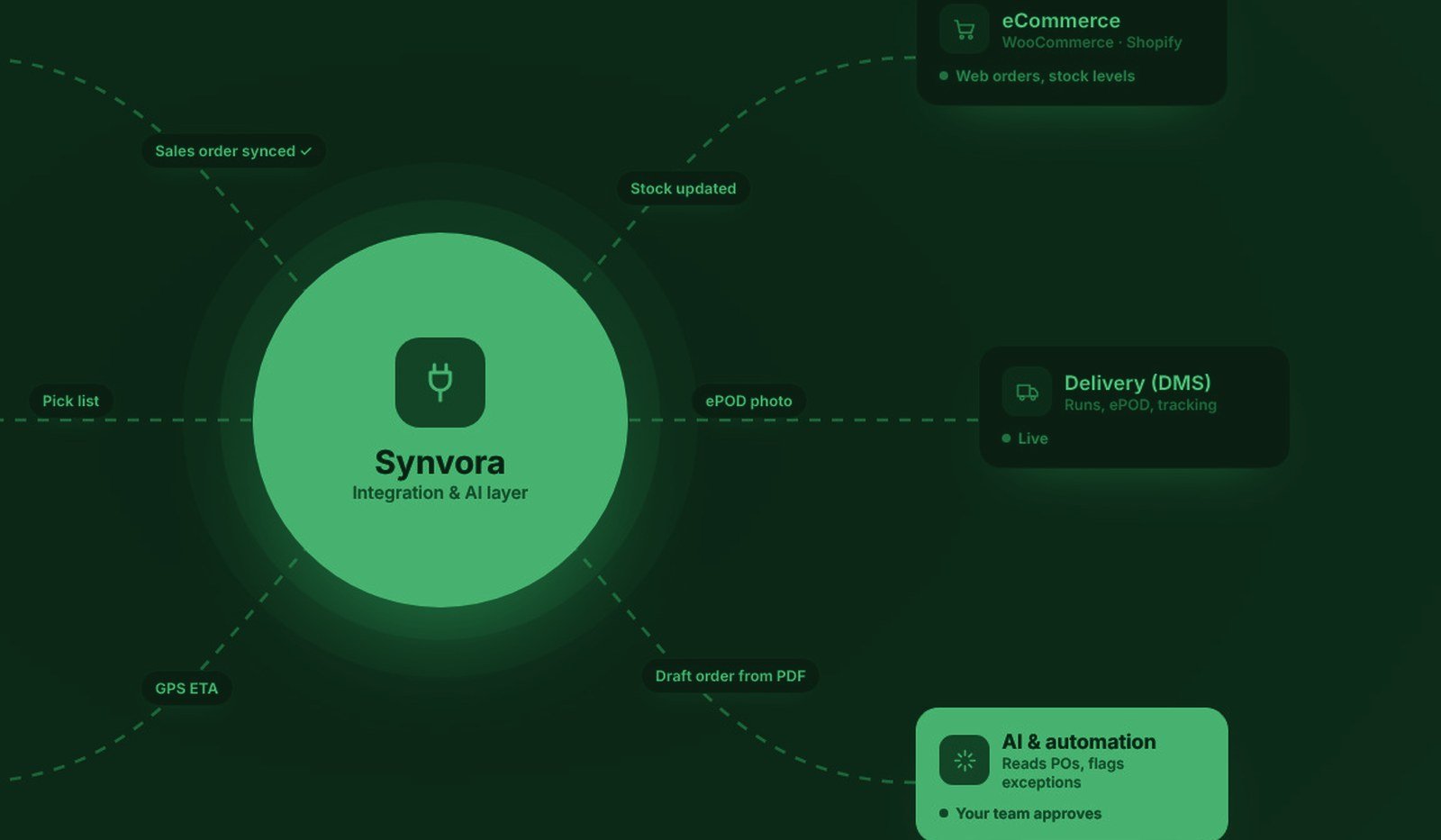
Agents run inside the modules you already use, monitoring orders, stock, routes and deliveries around the clock.
Each agent works out what needs doing and does it inside the limits you set — or brings it to the right person when a decision is needed.
Less time on dashboards, chasing updates and re-typing orders from PDFs and emails. Routine work keeps moving on its own.
Each agent works inside one module. Run the ones that match the problems you actually have.


Your delivery (DEL-4487) is now on the way.
New ETA: 2:30 pm
An agent that does one thing is easier to trust, easier to audit and easier to turn off than an assistant that claims to do everything.
Agents start in draft mode: they prepare the action and a person approves it. You decide, one agent at a time, which have earned the right to act alone.
Every action is logged with what the agent saw and why it acted. When someone asks why a customer got that message, there is an answer.
Agents run inside your own Synvora environment on Australian-hosted data, against the records you already keep.
SynvoraBot is the side you talk to — you ask it a question about orders, stock or deliveries and it answers. Agents work the other way around: they run in the background on a trigger and come to you. Same underlying platform, different job.
Not unless you turn that on. Every agent starts in draft mode, where it prepares the action and waits for a person. You can promote individual agents to act on their own once you trust them, and reverse that at any time.
It will, occasionally — any system that reads a messy PDF or predicts traffic will be wrong sometimes. That is why actions are logged and reversible, and why anything customer-facing is drafted rather than sent. Start with draft mode on the agents where a mistake would be visible.
No. Most clients start with one, against whichever problem is costing them the most — usually order entry or delivery exceptions. The rest can wait until the first one has proved itself.
Reasonably consistent data in the module the agent watches, and a decision about which actions may happen automatically. If your data is messy, the consulting audit will say so before anyone spends money on AI.
It replaces the checking, not the judgement. The work that disappears is watching a screen for something to go wrong and re-typing information between systems. The decisions stay with your team, which is the point of the approval step.
Tell us where your team loses the most time. We’ll tell you honestly whether an agent helps, or whether something simpler would.
Thanks — one of our consultants will be in touch within one business day to lock in a time.
In a hurry? Call +61 490 963 222.